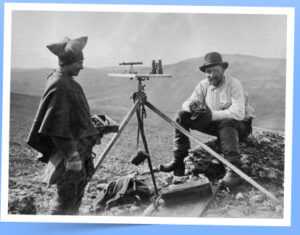
A Short History on Land Surveying

Land surveying is one of the the oldest professions anywhere. After any two individuals own property on opposite sides of a line – land surveying is important.

Land surveying is fascinating. The strategy used aim to determine which section of land is owned by whom, hopefully ending arguments for good.

To put it briefly, surveying is really a process using mathematical methods for surveying land to determine its ownership.

The first accounts of surveying land extends back to ancient Egypt. Experts have discovered evidences that the ancient Egyptians used basic geometry to redraw the lines of boundary when the Nile River overflowed. An Egyptian land register going back 3000 BC was found.

Following the Egyptians, the Romans – also the most powerful civilizations within the ancient world – practiced land surveying. They took it a pace further and made “land surveyor” an official position inside the Empire. These folks called agrimensores, often called Corpus Agrimensorum Romanorum. Despite the fact they used rather simple tools, these people were very thorough with their jobs and would create straight lines and proper angles with the use of these tools. As soon as the lines were measured, they’d create shallow ditches to mark the lines. Actually, much of the furrows they made continue to exist today.

One of several recorded land surveying of the “modern” times belongs to William the Conqueror who wrote the Domesday Book in 1086. This book is really a menu of names of land owners, the amount of land they owned as well as other information about the land. While it was a substantial volume of information during this period, the pieces of information weren’t 100% correct. The locations just weren’t accurate and the maps were not made to scale.

Among history’s greatest icons have also been an ardent surveyor – Napoleon Bonaparte. The interest in surveying land was really just a product of his wish to conquer the earth. Napoleon Bonaparte founded a registry referred to as cadastre. This includes a registry of properties of a county, ownership details, locations and as much information concerning the land’s value. Yes, Napoleon Bonaparte can be regarded as a land surveyor – plus a very smart man.

The strategies put to use in land surveying also have evolved over the centuries, over time. Long ago, people would use whatever could help them determine the distance from one point to another. This implies using chains with links and even ropes. Not surprisingly, this didn’t give accurate results but they did not have the technology we now have.

Today, land surveyors possess the best technologies to assist them with their job. There is GPS, or Global Positioning System, which is quite possibly the most accurate technologies available today. Total stations are also crucial to a land surveyor, which employs the utilization of an EDM or Electronic Distance Measurement device together with a theodolite which enables for further precise angle and distance measurements.

author avatar
Surveyor

More Posts

Drone collecting LiDAR mapping data by scanning the ground with laser beams to create accurate site models for modern projects
land surveying
Surveyor

Why New Project Deadlines Make LiDAR Mapping More Important

Boston is heading into another busy construction season, and this year the pressure feels higher than usual. The city just released a new round of municipal infrastructure bids, and many of these projects need fast and accurate site data before work can begin. That’s why LiDAR mapping is now in

Read More »
Topographic survey map with contour lines showing elevation changes and potential flood vulnerability across sloped terrain
land surveying
Surveyor

Could a Topographic Survey Expose a Silent Risk?

Coastal flooding has become a growing concern in Boston. In the last few days, several news outlets reported that more than 400 hazardous and toxic sites across New England are at risk from future coastal flooding. Many of them sit near the shoreline, old industrial zones, and busy port areas.

Read More »
Neighbors arguing near a backyard fence during a property line survey dispute
boundary surveying
Surveyor

How a Viral Feud Made Property Line Survey a Must

Every week, a strange dispute hits the internet. But one recent Massachusetts story caught everyone’s attention. A homeowner discovered that his neighbor had hired workers to remove large boulders on the edge of his yard. The neighbor claimed the town said it was fine. The police called it a civil

Read More »
Licensed land surveyor conducting a construction survey with a total station at an active construction site
land surveying
Surveyor

When Disaster Strikes: The Power of a Construction Survey

When a construction site turns into chaos—like the recent crane collapse and fire near UMass Amherst—one question always comes first: what happened, and how do we rebuild safely? That’s where a construction survey comes in. A licensed land surveyor might not wear a fire helmet or carry a rescue tool,

Read More »
A land surveyor using GPS equipment to complete a boundary line survey on a grassy residential lot
boundary surveying
Surveyor

When a Boundary Line Survey Beats a Smartphone Snap

In Boston, property lines can get messy fast. Homes sit close together, fences often run right to the edge, and every inch of land counts. Lately, more homeowners have been trying to settle property questions with quick screenshots or Google Earth images. But a recent Massachusetts court ruling just made

Read More »
Apprentice land surveyors learning to use total station under supervision during ALTA Land Title Survey fieldwork
alta survey
Surveyor

New Apprenticeships Reshape ALTA Land Title Survey Hiring

In Boston and across New England, new buildings and land projects are popping up fast. Before a property can be sold, financed, or developed, it needs one key document — an ALTA Land Title Survey. This detailed survey shows property lines, easements, and features so lenders, buyers, and title companies

Read More »