How To Find Your Property On FEMA’s Flood Insurance Rate Maps

What are FEMA flood maps?
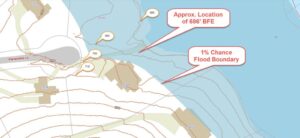
FEMA’s Flood Insurance Rate Maps (FIRMs) or just Flood Maps are provided after a flood risk assessment has been completed or updated for a community.  This study is known as a Flood Insurance Study.  The FIRM gives you the Base Flood Elevations (BFEs) and insurance risk zones in addition to floodplain boundaries.  The FIRM may also show a delineation of the regulatory floodway.

Once the “insurance risk zone”  (commonly referred to as the flood zone) is determined, actuarial rates, based on these risk zones, are then applied for newly constructed, substantially approved, and substantially damaged buildings.  FEMA uses these rates to determine the insurance rate you will pay for flood insurance

FEMA’s Digital Flood Maps

FEMA discontinued the production and distribution of paper flood maps in 2009 as part of its Digital Vision Initiative. This affected all the Flood Maps, boundary information, and study reports. However, clients can still view the products for free through their website or buy them in digital format.

To view these flood maps online, go to FEMA’s Map Service Center and key in your address (hi-lited area shown here) search for your home.  This will prompt you to then select the map that covers your area.  The Flood Maps are somewhat cumbersome to use online. It is best to go through the tutorial on the bottom right of the address search page for an easier and more effective use of the GIS map.

author avatar
Surveyor

More Posts

Drone land surveying being conducted by a professional surveyor at an active urban construction site
land surveying
Surveyor

Why Drone Land Surveying Workflows Are Changing

Drone land surveying changed how cities are measured. For years, drones helped surveyors work faster, safer, and with fewer boots on the ground. In dense cities, that mattered a lot. Tight lots, tall buildings, and busy streets made aerial data a smart solution. However, things are shifting. Not because drones

Read More »
Developers reviewing an ALTA survey during a commercial real estate deal discussion
alta survey
Surveyor

Why Developers Rethink the ALTA Survey After Deal Delays

In Boston’s fast-moving commercial market, timing matters. Over the past year, many deals have slowed down right before closing. In many cases, the issue was not financing or zoning. It was the alta survey. Developers who once treated the survey as a late-stage task now see it as a critical

Read More »
Aerial view of residential properties where a boundary survey helps confirm property lines
boundary surveying
Surveyor

Property Tax Changes: Why a Boundary Survey Matters Now

Homeowners are feeling uneasy—and for good reason. With talk of a major residential property tax increase spreading fast online, many people have started to look closely at their own assessments. Social media threads and Reddit discussions are full of screenshots, comparisons, and frustration. In the middle of all this noise,

Read More »
A worker uses a drone for aerial surveying at a redevelopment site
land surveying
Surveyor

How Aerial Surveying Improves Flood Planning and Development

Boston changes fast. New buildings go up, old streets shift, and storms hit harder every year. Because of these challenges, the city now relies more on aerial surveying to map land, understand risks, and plan smarter projects. This method gives clearer data, quicker results, and a better way to protect

Read More »
Drone collecting LiDAR mapping data by scanning the ground with laser beams to create accurate site models for modern projects
land surveying
Surveyor

Why New Project Deadlines Make LiDAR Mapping More Important

Boston is heading into another busy construction season, and this year the pressure feels higher than usual. The city just released a new round of municipal infrastructure bids, and many of these projects need fast and accurate site data before work can begin. That’s why LiDAR mapping is now in

Read More »
Topographic survey map with contour lines showing elevation changes and potential flood vulnerability across sloped terrain
land surveying
Surveyor

Could a Topographic Survey Expose a Silent Risk?

Coastal flooding has become a growing concern in Boston. In the last few days, several news outlets reported that more than 400 hazardous and toxic sites across New England are at risk from future coastal flooding. Many of them sit near the shoreline, old industrial zones, and busy port areas.

Read More »