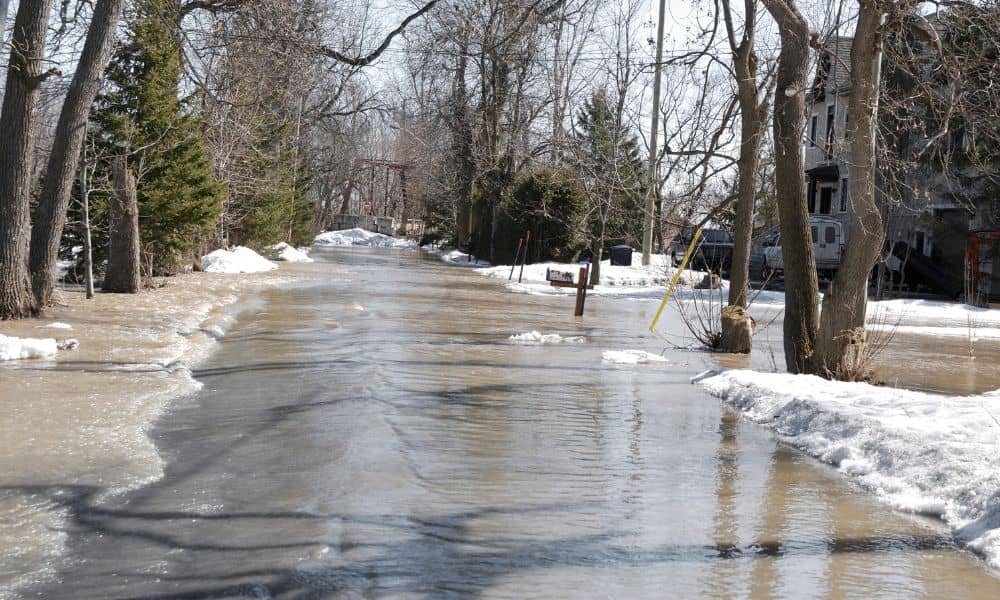
You’ve seen it: a winter storm rolls through, the tide runs high, and one block ends up under water while the next block stays mostly dry. Then the same question pops up: “Why here?” Around Boston, this turns into a winter headache fast. Water pools, then it freezes. After that, you deal with skids, slip hazards, blocked driveways, and nonstop complaints. Here’s the key: this problem usually starts with inches, not feet. A small dip in pavement, a low curb line, or a clogged drain can decide the outcome. That’s exactly where lidar mapping massachusetts helps.
Why one block floods first
Water follows the lowest route, even when the drop looks tiny.
First, pavement settles. Utility patches and heavy traffic can leave shallow “bowls,” so puddles return to the same spot.
Next, curbs and road crowns steer flow along the gutter. If one curb section sits slightly lower, water stacks up there and spreads across the lane.
Then winter makes it worse. Plows push snow toward catch basins (street drains). Ice can lock around the grate. As a result, water can’t enter, so it searches for the next-lowest escape.
Coastal areas add another twist. During high tide and strong winds, splashover can hit the road early. That water runs downhill in a thin sheet. If it reaches a low point, it pools and freezes fast.
Why “eyeballing it” fails
When flooding hits, people blame the closest drain or the lowest yard. Those guesses feel right, but they often miss the true start point.
Snow also hides the surface. A road can look smooth under a thin layer of snow, yet the ground below has small dips and ridges. Those small shapes control the flow, especially on gentle slopes.
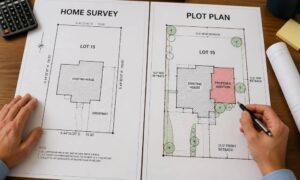
So broad flood maps and old site plans don’t solve the curb-to-curb mystery. They don’t show where pooling begins or where water goes when an inlet fails.
What lidar mapping reveals
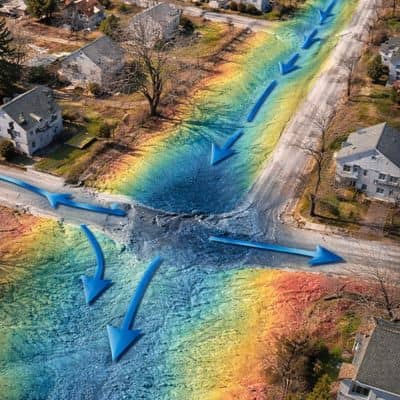
LiDAR uses laser pulses to measure distance. In simple terms, it samples the ground thousands of times per second. Those measurements form a dense 3D point cloud. From that, you can build a ground surface that shows subtle elevation changes your eyes miss.
For the “one block” problem, LiDAR helps you see the exact low points, the flow path water follows when drains clog, and the spots where water spills from street to sidewalk or parking areas. Once you see those patterns, you stop guessing—and you stop fixing the wrong spot.
Just as important, you get visuals that regular people understand. A simple shaded image can show the “bowl.” A low-point map can show where ponding starts. Flow arrows can show where the water wants to go. Then you can share those images with residents, tenants, or a board and keep everyone on the same page.
A Boston-area story that happens every winter
Picture a coastal-adjacent road near Boston with a gentle slope toward an intersection. During a high tide event, spray reaches the street. Later, snowmelt adds more water.
The flow rides the curb line and reaches a subtle low point near the corner—maybe a four-inch dip from pavement settlement. At the same time, plowed snow blocks the nearest catch basin. The inlet can’t keep up, so water backs up, spreads across the crosswalk, and freezes overnight.
The next block stays fine, not because it has better luck, but because it sits slightly higher and has a working outlet path.
With lidar mapping massachusetts, that dip won’t hide. The flow line won’t hide either. You can point to the true collection point and say, “This is where it starts.”
What clients do with the results
Most clients don’t want more data. They want a simple, defensible plan.
For municipalities and DPW teams, LiDAR helps prioritize the worst corners first and explain the “why” to stakeholders. It also helps you document the problem location before you spend money, which makes future decisions easier.
For property managers, it explains why an entrance or a walkway ices up, even after crews shovel and salt. Then you can protect the right drain, change snow placement, or fix a small dip. That matters, because fewer ice hot-spots can reduce risk and cut repeat service calls.
For developers and civil teams, LiDAR spots hidden low areas that feed the site. Then you can plan drainage early and avoid expensive changes later.
Across Massachusetts, you’ll see the same pattern after big coastal storms.
The “fix-first” moves that often work
Once you understand the surface, the best fixes usually look focused.
Sometimes you start with maintenance: clear and protect the inlet at the true collection point, not the one closest to the complaint.
Other times you make a small upgrade: add capacity where water already gathers, or adjust grading at a hidden dip so water drains away instead of pooling.
You can also improve winter operations by keeping snow storage away from key basins and clearing the “flood-first” blocks before a high tide window. Even small changes can help, because they keep water moving instead of sitting and freezing.
Closing: solve the mystery before the next storm
Flooding doesn’t pick random streets. It follows the surface you have, not the surface you think you have. When one block goes under water and the next block stays dry, the answer often sits in a few inches of elevation and a missed route for water.
That’s why lidar mapping works so well for this problem. It turns into a frustrating “why here?” into a clear picture. And once you see the picture, you can fix the right spot first.